Point de Gaze
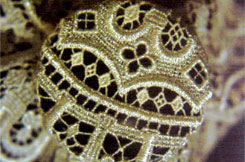
Despite the fact that the cities of Flanders distinguished themselves especially for the realization of bobbin lace, because of the local abundance in the raw material, linen, spun and blanched to perfection, they showed great skill and creativity in needle lace too. The Point de Gaze is a Belgian lace that developed in the nineteenth century and soon spread all over Europe.
Technically very similar to the Alençon lace, it can be distinguished because of the very thin, soft almost impalpable ground net, made of two very thin threads twisted twice. It was realized sewing together many small pieces with invisible stitches.
The ornamental motives that characterize this type of lace are mostly composed of large and refined floral compositions that fill the entire lace, with complex patterns representing flowered gardens and varied floral patterns.
Further reading:
Cfr. A. Kraatz, S.M.Trkulja, A.M.Mura (a cura di), Merletti a Palazzo Davanzati. Manifatture europee dal XVI al XX secolo, Firenze, 1981.